Deep, clear blue diamonds are the rarest and most legendary of all colored diamonds, possessing a cool, ethereal blue that combines the brilliance of a diamond with the unique romance of a gemstone. From the formation of natural blue diamonds to the legends of historic diamonds, and the development of lab-grown blue diamond technology, this shade of blue is interwoven with the evolution of earth science, the history of jewelry development , and modern industrial technology.
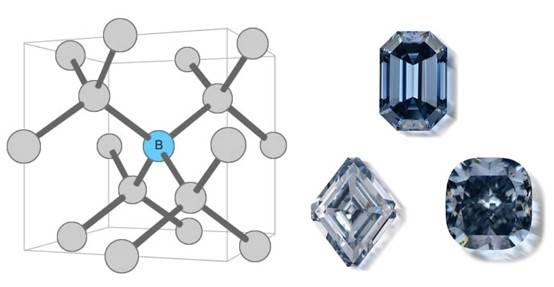
Most ordinary diamonds are formed in the upper mantle at a depth of 150-200 kilometers, while natural blue diamonds are formed in the lower mantle at a depth of 660-750 kilometers , which is four times the depth of ordinary diamonds, and the formation environment is extremely harsh.
As ancient oceanic crust sank into the mantle along with tectonic plates, trace amounts of boron, enriched in the oceanic sedimentary layers, also reached the depths of the mantle. Under high temperature and pressure, these trace boron atoms randomly replaced carbon atoms in the diamond lattice, forming a unique electronic defect structure that selectively absorbs red and yellow light, ultimately resulting in a distinctive blue hue.
Classical Origins Stage: From the 15th to the 17th centuries, Golconda, India, was the world's only source of blue diamonds. The rough stones were enshrined in Hindu temples and later flowed into European royal families. In the 17th century, the French royal family collected the legendary Blue of France, which, after several changes of ownership and dismantling, evolved into the world-famous Hope Diamond. During the same period, the Wittelsbach Blue Diamond passed through the hands of several royal families, establishing the noble and mysterious jewelry status of blue diamonds. At that time, blue diamonds were exclusively for the wealthy and powerful, with no channels for their circulation among the general public.
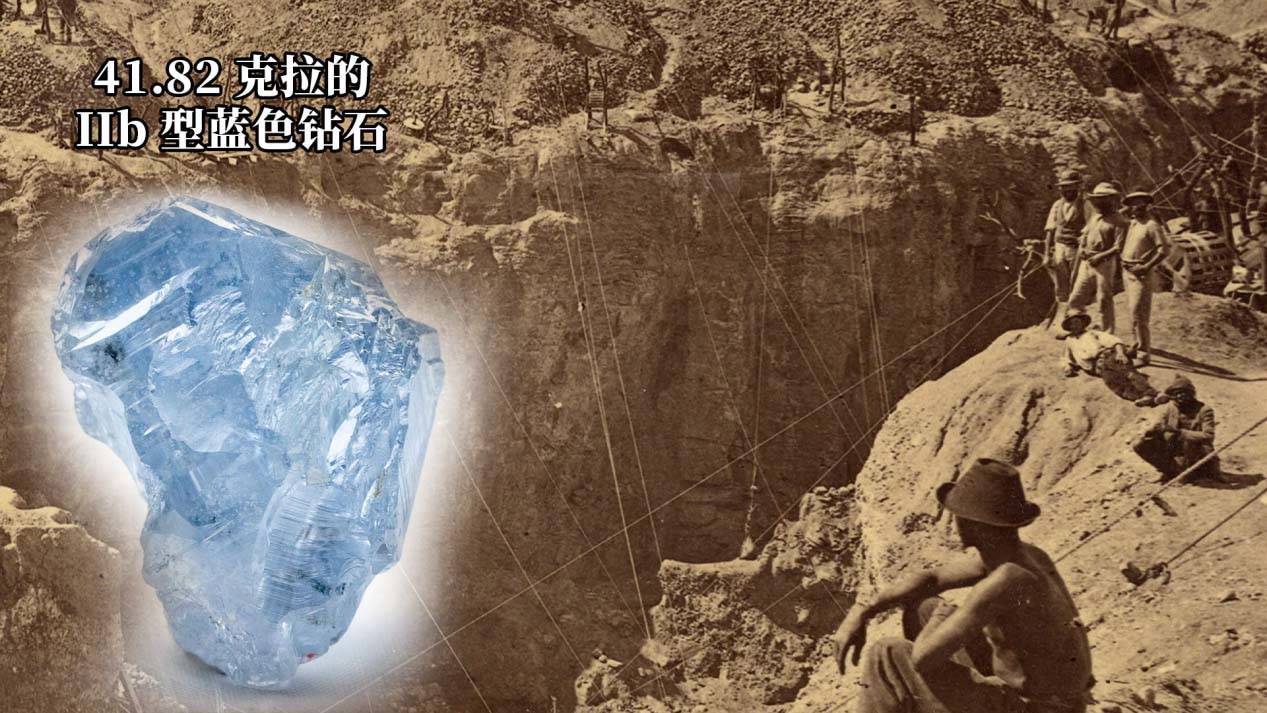
Modern mining phase: In 1902, the Cullinan mine in South Africa began production, officially replacing the Indian mines and monopolizing the global production of large-carat, high-quality natural blue diamonds. Since the 21st century, the mine has continuously unearthed heavyweight fancy vivid blue diamonds, with the Oppenheimer Blue Diamond and the Josephine Blue Moon breaking auction records one after another, raising the global collectible value of blue diamonds.
For a long time, exorbitant prices and scarcity of resources have firmly locked up the natural colored diamond market, leaving only inexpensive irradiated white diamonds with grayish hues and distorted colors, resulting in minimal gem value. With the development of lab-grown diamond technology and the widespread availability of lab-grown colored diamonds , the centuries-old resource monopoly of natural colored diamonds has been completely broken , reshaping the global colored diamond industry landscape.
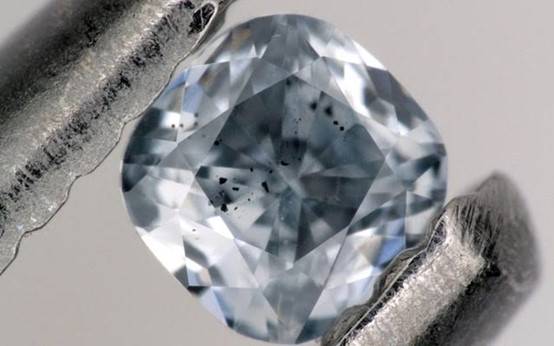
Early cultured blue diamonds replicate the original coloring logic of natural type IIb blue diamonds. Trace amounts of boron are directionally doped during the diamond growth stage. The crystal structure and coloring mechanism are completely identical to those of top-grade natural blue diamonds, resulting in a warm and pure color tone. However, the production cost is relatively high and mass production is difficult.
Until the irradiation + annealing color-changing process matured, the production cost was lower and the range of adjustable colors was wider. Early process products had a grayish tone and insufficient color saturation, resulting in low market acceptance. Subsequent optimization and upgrading of the heat treatment process greatly improved the color purity, making it the core preparation method for mass-market consumer-grade cultured blue diamonds.
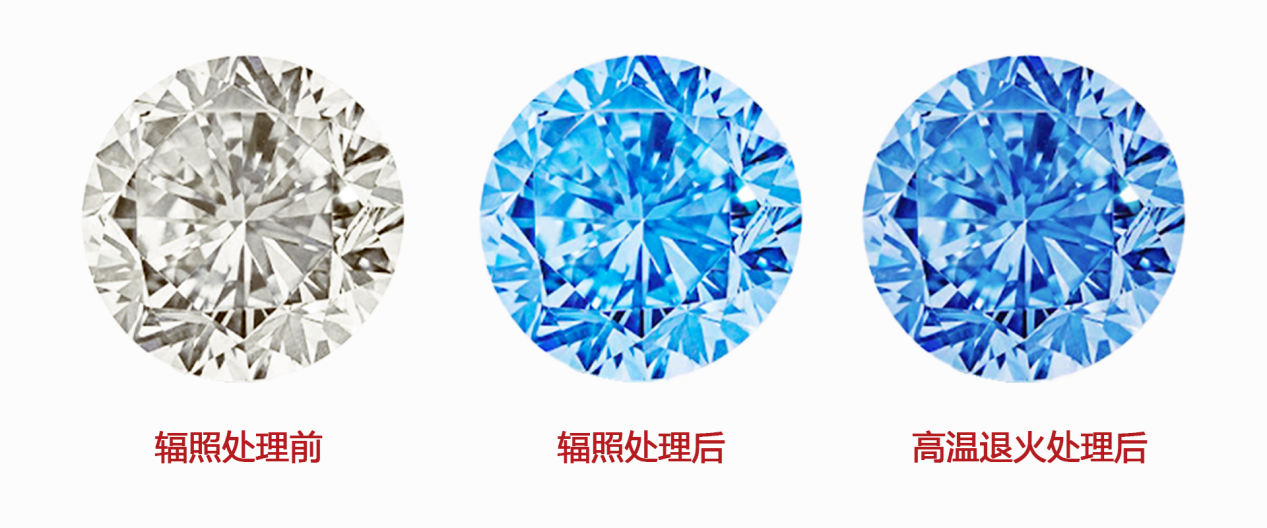
It uses a colorless or light brown cultured white diamond substrate and high-energy electron beams to bombard the diamond carbon lattice. The high-speed electrons collide with the carbon atoms inside the lattice , creating a large number of lattice holes (color centers) inside the crystal . The color centers absorb red, orange, and yellow light in the visible light band, and the crystal initially appears light blue or grayish-blue. There is no radioactive residue throughout the process, and it is safe to wear without any hidden dangers.
After irradiation, the diamonds are placed in a vacuum heat treatment furnace and annealed at a constant temperature using a gradient heating mode of 700–1700℃ . This allows the disordered lattice defects caused by irradiation to migrate due to heat, eliminating the haze and gray centers caused by irradiation, and stabilizing the blue absorption spectrum. By precisely controlling the temperature to adjust the density of the color centers, it is possible to produce cultured blue diamonds with a full range of colors, including light blue, deep blue, and vivid blue, with uniform and transparent colors.
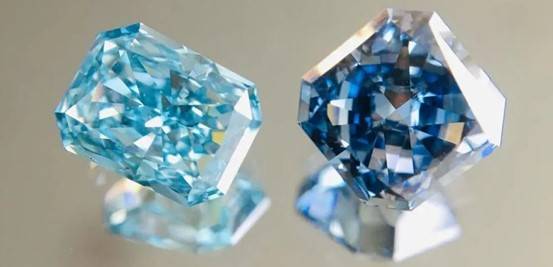
The advent of lab-grown blue diamonds has completely broken the market monopoly of natural blue diamonds. Both have their advantages and disadvantages, and are suitable for different consumer and collection needs.
① Affordable prices and significantly lower entry barriers
Lab-grown blue diamonds offer excellent value for money. With the same 4Cs, their price is only 5% to 12% of that of natural blue diamonds , making fancy vivid blue diamond jewelry accessible to ordinary consumers and breaking the monopoly of high-end collections of natural blue diamonds.
② Color quality is controllable, with fewer defects.
The controlled production environment in the laboratory ensures that cultured blue diamonds have uniform and saturated colors with very few flaws, perfectly avoiding the shortcomings of natural blue diamonds, such as random appearance and many impurities. Moreover, the production process does not require mining, making it ecological and environmentally friendly .
③The physical and chemical properties are basically the same.
Cultured blue diamonds have the same hardness, refractive index, dispersion, and thermal conductivity as natural blue diamonds, and cannot be distinguished by the naked eye or a magnifying glass. They possess the same brilliance and wear-resistant stability .
IV. Industry Transformation: Iterative Upgrading of Testing Standards
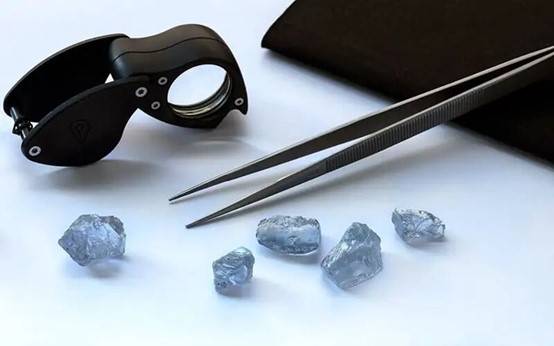
The widespread adoption of cultured colored diamonds has not only changed the blue diamond market landscape but also had a disruptive impact on the traditional jewelry testing industry. In the early days of the jewelry testing industry, the core task was to distinguish between natural diamonds, synthetic diamonds, artificially colored diamonds, and various imitation diamonds. In the early days, the mass market was dominated by counterfeit products, and identification could be completed with basic instruments and the naked eye.
However, irradiated annealed and boron-doped cultured blue diamonds are highly similar in appearance and physical parameters to natural Type IIb blue diamonds, making it impossible for conventional testing methods to accurately distinguish their categories and trace the causes of their color. This industry identification challenge has, in turn, driven the upgrading of gem testing technology. The Giero Gem Laboratory, relying on high-precision spectral analysis and cathodoluminescence imaging technology, accurately classifies colored diamonds into three categories: natural, cultured, and artificially colored.
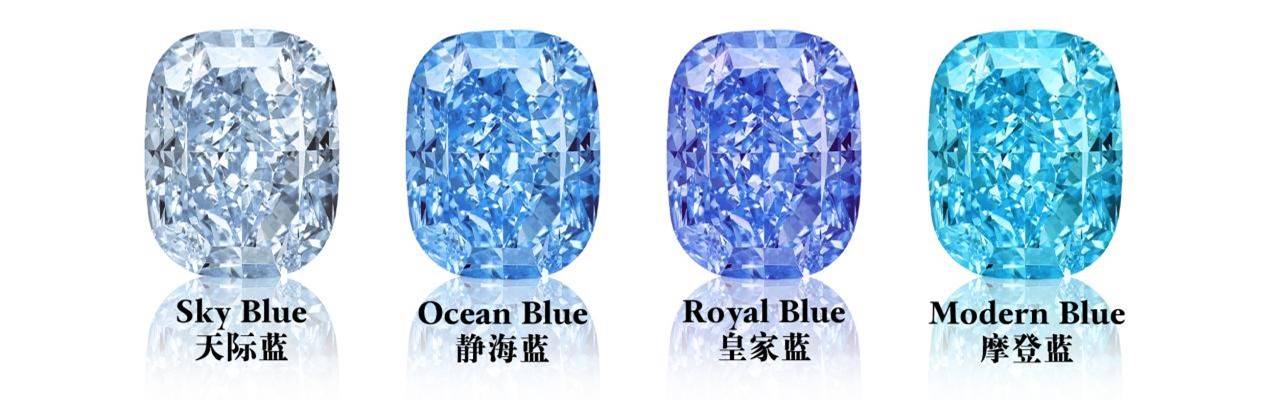
To address the industry pain point that traditional grading systems are not well-suited for lab-grown colored diamonds, and based on years of experience and expertise in gem testing, Giero has innovatively launched a 4C+5G grading system specifically for lab-grown colored diamonds . This system is built upon scientific spectrophotometry, standard light source grading, and industry market demands, allowing for the definition of color, quantification of grade, comparison of value, and traceability of certificates for lab-grown colored diamonds.
The "4C+5G" grading system consists of two main parts: the 4C color classification system and the 5G brightness grading system. Taking blue diamonds as an example, it is subdivided into four major sub-color systems based on overtone characteristics, using Chinese and English commercial names, which are both professional and clear, close to market communication, and easy for consumers to remember quickly.
Natural blue diamonds are rare treasures gifted by millions of years of geological activity on Earth, carrying profound geological value and cultural history, and are timeless classics in the high-end collectibles field. Meanwhile, lab-grown blue diamonds, relying on advanced technology, offer high cost-effectiveness and high quality, bringing the allure of this exquisitely blue diamond into everyday life. The two complement each other, satisfying differentiated market demands. With continuously improving industry standards and upgraded testing technologies, the Giero 4C+5G grading system safeguards the lab-grown colored diamond industry, protecting the rare collectible value of natural blue diamonds while promoting the standardized and sustainable development of the lab-grown blue diamond industry, allowing this unique deep-sea blue of diamonds to shine with new brilliance in the new era.